
Manufacturing & Warehousing
Inventory Management: Optimizing Manufacturing and Warehousing
Delivered for a manufacturing and warehousing business.
Engagement snapshot
- Sector
- Manufacturing & Warehousing
- Client
- A manufacturing and warehousing business
- Engagement type
- Custom inventory management build
- What we built
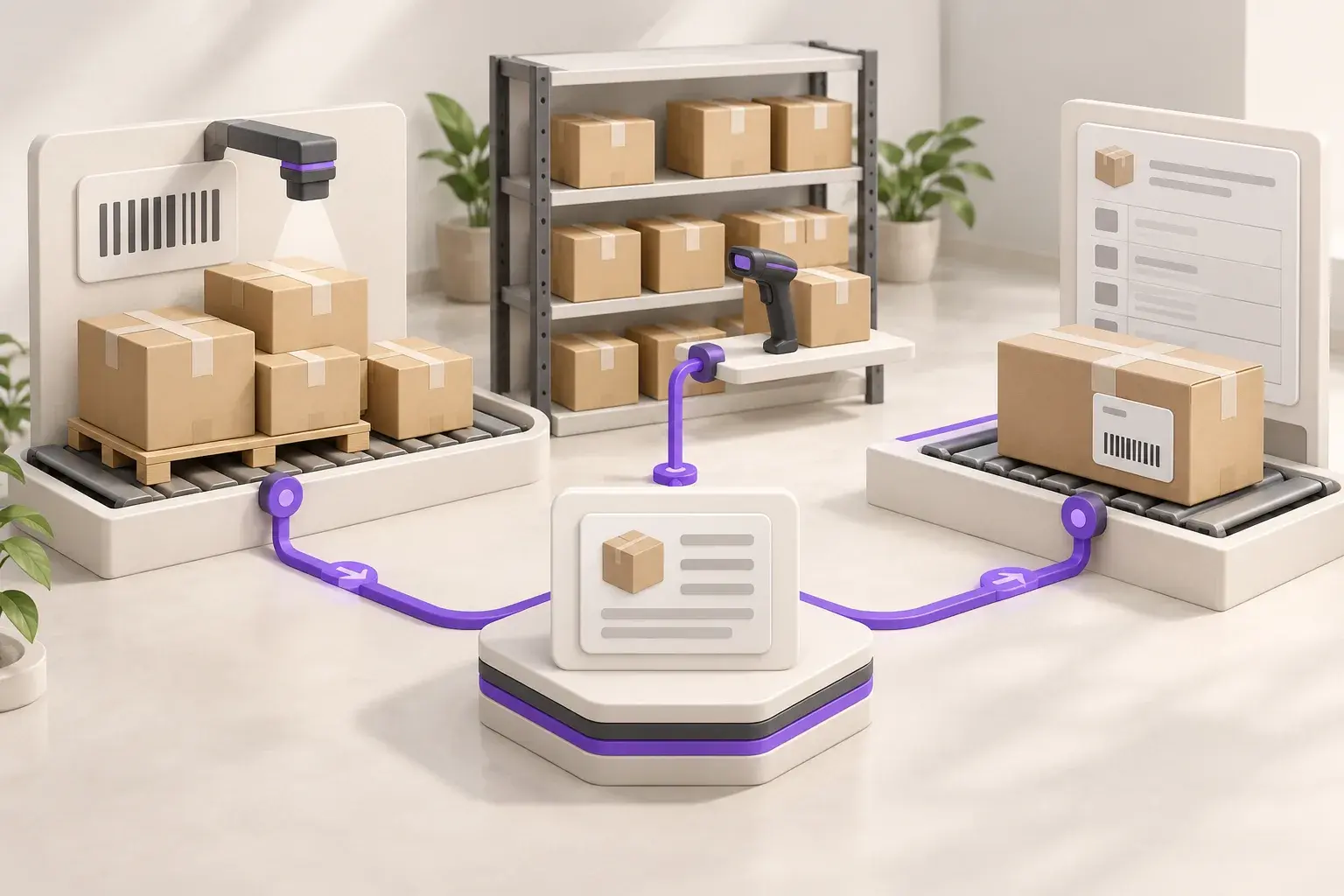
- Barcode and QR scanning with a central stock dashboard across warehouse and production
- Platform
- Progressive Web App (PWA)
Where they started
- Finding a specific product meant a manual, visual search across the warehouse or production floor.
- Every scan or count depended on someone writing the number down by hand, so mistakes carried into the stock records.
- Products had no standard label, so identifying an item depended on whoever had packed it.
- Stock records for the warehouse and the production floor lived separately, so an audit meant reconciling both by hand.
What we built
A progressive web app for warehouse and production
The PWA combines scanning, labels and stock information in an application staff can access through supported devices.
A scan replaces the manual lookup
Barcode and QR scanning are built to match the client's own identification scheme, so finding or logging a product is a scan instead of a search.
Printable labels are generated automatically
Printable tags are generated automatically and can be reconfigured for new products, so labeling a new item does not wait on a manual template.
One dashboard for every stock number
Warehouse and production stock appear in the same real-time dashboard, so a stock check does not depend on which building someone is standing in.
Access matches the role
Permissions are set user by user, so a warehouse operator and a floor supervisor each see and edit only what their job requires.
Fast search through the inventory list
Fast search and categorization tools locate a specific item inside a large inventory list, instead of scrolling through it by hand.
What changed
Finding stock takes one scan
Because identification runs through a barcode or QR scan, locating or logging an item takes the time of a scan instead of a walk down the aisle.
Errors drop because entry is automated
Scanning and automated logging remove the manual data entry step, so the number in the system matches what is physically on the shelf more consistently.
One number for every location
Warehouse and production stock report into the same dashboard, so a stock count no longer means reconciling two separate records.
Simpler stock audits
Centralised stock information gives staff a shared starting point for audits across warehouse and production.
When finding a product means walking the floor
Identifying a specific item meant a manual, visual search across the warehouse or the production floor, and every scan or count that followed depended on someone writing a number down by hand. As product volume and variety increased, that combination produced slow lookups and errors that carried straight into the stock records, and reconciling the warehouse against production for an audit meant comparing two records that rarely agreed with each other.
Building a system around a scan instead of a search
We designed the tool as a progressive web app for use across supported devices on the warehouse and production floor. Custom barcode and QR scanning replaced the manual lookup, matched to the client’s own product identification scheme, and a labeling feature generated printable tags automatically so a new product did not wait on someone to build a template by hand. A central dashboard then brought warehouse and production stock into one real-time view, with user-wise permissions controlling who could see or edit what, and fast search and categorization tools cut through inventory lists that had grown too large to scroll through.
Fewer errors, one number for the whole operation
With identification running through a scan and logging happening automatically, manual-entry errors were reduced. Warehouse and production stock now report into the same dashboard, so staff can review stock from a shared record when preparing an audit. The client’s product tracking, from receipt through to dispatch, now runs at the speed a scaling operation needed.
Our manufacturing software work connects production, inventory and departmental records around the operation.
Services used on this build
Have a process that looks like this one?
Tell us which workflow you want to improve and the systems it depends on. We will help define a practical starting point.