Business Process Automation

AI agents and assistants for intelligent business workflows

We build AI agents and intelligent assistants that extend your team's capabilities. From knowledge-based Q&A to task-executing agents, we engineer the AI capability around your requirements, data and guardrails.

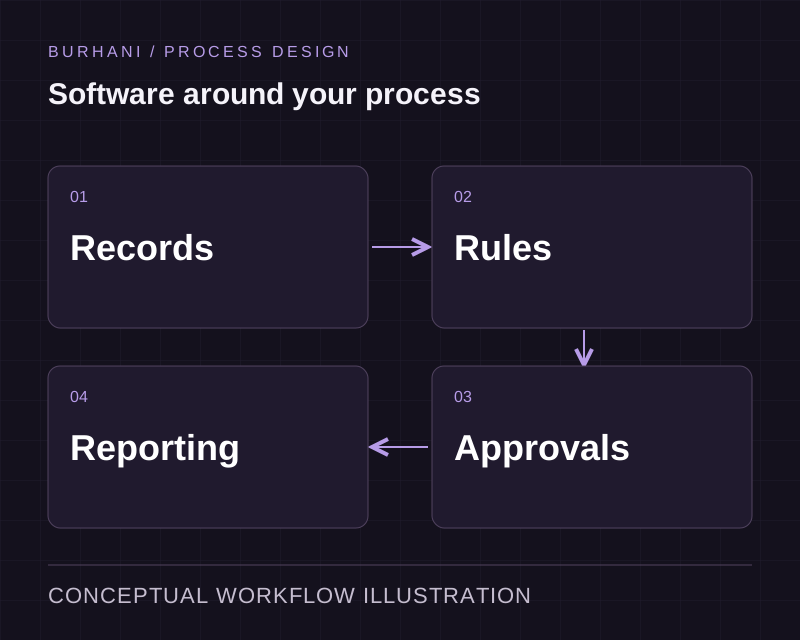
Conceptual process illustration for AI Agents & Assistants
  • Built with frontier and specialized models
  • Engineered with guardrails and validation
  • Human oversight where needed

The starting point

When information retrieval and routine decisions take too long

Our team spends hours searching internal documents for information.

A knowledge-based assistant can retrieve and synthesize information from your documentation, making expertise accessible to everyone who needs it.

We want to use AI but we cannot have it updating records without validation.

Agents can be built with permission layers and confirmation steps, so updates are proposed rather than executed blindly.

What the work includes

Engineer AI capabilities with proper boundaries

We define the task, the information sources, the actions permitted and the validation steps required. Model selection follows the requirements rather than the other way round. Agents are tested against representative inputs, edge cases and failure scenarios before deployment.

Explore the delivery process
Knowledge retrieval assistants

Query your documentation, technical specs or historical records and get answers grounded in your actual information.

Task-executing agents

Agents that can perform permitted actions like scheduling, record updates or report generation, with validation checkpoints.

Decision support systems

Present options, compare alternatives and highlight considerations based on your rules and historical decisions.

Multi-agent workflows

Coordinated agents where one specializes in research, another in validation, and a third in execution.

Guardrails and oversight

Permission boundaries, output validation, human confirmation steps and audit logs for every AI action.

Start with a defined task and clear boundaries

An effective AI agent knows what it can do, what information it can access, and when to ask for human input. We define the permitted actions, validation rules and escalation path before model selection.

Knowledge assistants retrieve from your designated sources. Task-executing agents operate within bounded permissions. Decision support presents options without forcing a choice. Match the agent design to the level of autonomy the task requires.

Test against edge cases and failure scenarios

Evaluate the agent on complete user tasks, including missing information, conflicting data and requests outside its scope. Those checks determine whether the agent is ready for wider deployment or needs tighter guardrails.

For agents that need to execute actions across systems, integration services connect the tools and records involved. Guardrails define which actions are permitted and which require confirmation.

From discovery to support

From requirements to deployed agent

Discuss your requirements
  1. 01Discovery

    We walk your current workflow with the people who run it and record where work stalls, duplicates or waits.

  2. 02Scope and quote

    A fixed price and a dated plan, issued after discovery. Payment runs against milestones.

  3. 03Design

    Review the proposed workflow, interfaces and data requirements before implementation. The design work follows the scope of the project.

  4. 04Build and review

    Implement the agreed scope in short cycles, review the changes and test the behaviour with representative records and exceptions.

  5. 05Integrate and release

    Test the required connections, confirm acceptance with your team and release according to the agreed rollout plan.

  6. 06Support

    The team that built it handles updates, integrations and support calls after go-live.

How we can work together

Projects here typically run between USD 7,500 and USD 15,000 or above, depending on scope. We quote a fixed price after discovery and bill against milestones.

Fixed price

Fits when: Scope is clear and agreed after discovery

Billing: Milestone payments against a dated plan

Dedicated team

Fits when: Scope will evolve, and you want capacity reserved

Billing: Monthly, per named engineer

Support retainer

Fits when: The system is live and needs changes and cover

Billing: Monthly, with an agreed response window

Questions about AI Agents & Assistants

How do you decide which AI model to use?

We compare candidate models on representative inputs from your work, measuring accuracy, response time and cost. Frontier models are one option for complex reasoning. Specialized or smaller models may fit simpler tasks better and run cheaper.

Can the AI agent update our production records?

Only with the permissions and validation steps you define. Agents can propose changes for human approval, execute within bounded parameters, or require two-factor confirmation for critical updates. We design the guardrails alongside the capability.

What happens when the AI cannot answer or gets it wrong?

The agent should acknowledge uncertainty rather than guess. We build confidence thresholds, fallback paths to human experts, and validation checks. Every response can be logged for review.

How do you keep the AI grounded in our actual information?

We use retrieval-augmented generation (RAG) to pull from your designated knowledge base before generating responses. The agent cites sources, and you control which documents it can access.

Can we have multiple specialized agents working together?

Yes. One agent retrieves information, another validates it, a third executes based on the result. Multi-agent systems can handle complex workflows where a single model would struggle with the full sequence.

Define your first AI agent

Bring the task, the information it needs and the actions it should take. We will assess model options, guardrails and validation steps.