Custom Software Development

Cross-platform application development for business systems

Share application logic across web, mobile and desktop where it suits the work. We choose the framework around your users and device requirements, then test the behaviour on each supported platform.

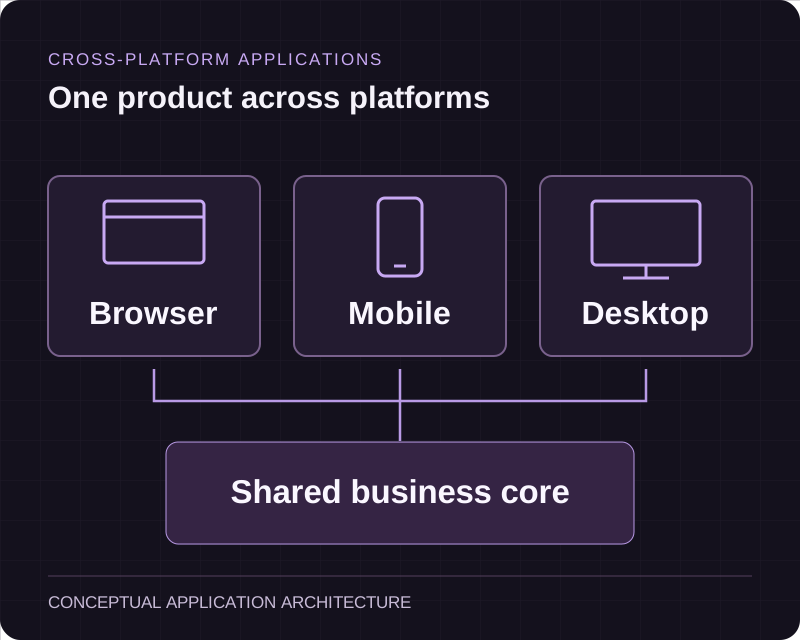
Conceptual process illustration for Cross-Platform Enterprise Apps
  • React Native and Flutter
  • Shared business logic
  • Testing across target platforms

The starting point

When separate applications duplicate the same work

The Android app has a feature the iPhone one does not, and nobody can say why.

Two codebases drift the moment two teams work on them. The gap starts small and becomes permanent.

We cannot afford three builds of the same tool.

Separate implementations repeat some development and testing work. A shared codebase can reduce that duplication, with platform-specific work retained where it is needed.

What the work includes

Share the logic and test each platform

We separate shared business rules and data access from the platform-specific features. The supported devices, interfaces and distribution requirements guide the framework choice. Build and testing arrangements account for every target in the agreed scope.

Explore the delivery process
Shared business logic and data layer

Rules, validation and sync written once, so behaviour cannot quietly differ between an Android phone and a browser.

Platform-specific interface where it matters

Navigation and input patterns follow each platform's conventions, so the app feels native rather than ported.

Offline behaviour and sync

Local storage with conflict handling, for teams who work where connectivity is unreliable.

Single release pipeline

A coordinated build process for the supported targets, with platform checks and store submissions included in the release plan.

Device capability access

Camera, scanning, location and file handling, wired through a shared interface.

Decide what can be shared before choosing the framework

Business rules, validation and data access are good candidates for reuse. Camera behaviour, notifications, background activity and navigation still need checking on each target. Agree the supported platforms and device capabilities before selecting the shared foundation.

Our mobile development service covers field and hardware requirements. A browser interface may share the underlying rules while presenting a different workflow for office users.

Keep releases manageable across platforms

A shared foundation reduces duplicated changes, but each release still needs platform checks. App-store review may affect when an update reaches users. Build those checks and approval steps into the delivery plan.

DevOps and maintenance supports the build and test pipeline. Record the supported versions and dependencies so the team can assess the impact of a framework update before scheduling it.

From discovery to support

From shared components to platform releases

Discuss your requirements
  1. 01Discovery

    We walk your current workflow with the people who run it and record where work stalls, duplicates or waits.

  2. 02Scope and quote

    A fixed price and a dated plan, issued after discovery. Payment runs against milestones.

  3. 03Design

    Review the proposed workflow, interfaces and data requirements before implementation. The design work follows the scope of the project.

  4. 04Build and review

    Implement the agreed scope in short cycles, review the changes and test the behaviour with representative records and exceptions.

  5. 05Integrate and release

    Test the required connections, confirm acceptance with your team and release according to the agreed rollout plan.

  6. 06Support

    The team that built it handles updates, integrations and support calls after go-live.

How we can work together

Projects here typically run between USD 7,500 and USD 15,000 or above, depending on scope. We quote a fixed price after discovery and bill against milestones.

Fixed price

Fits when: Scope is clear and agreed after discovery

Billing: Milestone payments against a dated plan

Dedicated team

Fits when: Scope will evolve, and you want capacity reserved

Billing: Monthly, per named engineer

Support retainer

Fits when: The system is live and needs changes and cover

Billing: Monthly, with an agreed response window

Questions about Cross-Platform Enterprise Apps

When is cross-platform the wrong choice?

When the application depends heavily on a platform-specific capability, needs the last few percent of graphics performance, or must adopt a new operating system feature the day it ships. In those cases native is worth the extra cost and we will say so.

React Native or Flutter?

React Native where you already have JavaScript skills in-house and the app leans on the web ecosystem. Flutter where consistent rendering across platforms matters most and the interface is heavily custom. Both are production grade, so the decision is about your team as much as the app.

Can we start on one platform and add others later?

Yes, and it is a sensible way to start. Building on a cross-platform base from day one means adding the second platform later is a release rather than a rebuild, even if you only ship Android at first.

How do app store submissions work?

We handle the build, the store listings and the submission for both stores, and we stay on it through review. Store rejections on business applications usually come down to account access for reviewers, which we prepare for in advance.

How is testing handled across platforms?

Shared logic is covered by automated tests once. Platform-specific behaviour is tested on real devices, because emulators do not reproduce camera behaviour, network flakiness or the way a device throttles a background process.

Choose the platforms your application needs

Tell us where people will use the software and which device features matter. We can assess what to share and what needs platform-specific work.